More than you paid for: How Nitori built Japan’s answer to IKEA
A look inside Nitori’s vertical integration and ‘100x thinking’ that built a $6 billion business empire that keeps growing through recessions.
In 1975, on the snowy outskirts of Sapporo, a giant air dome inflated over a bare plot of land. Inside, the floor displayed sofas, curtains, and coordinated living sets—all priced to move. The man behind this unconventional retail experiment was Akio Nitori, a 30-year-old former ad agency employee who had started the company with no formal retail training. What he possessed instead was a growing obsession with price, logistics, and the ineffable quality that makes a home feel whole. Thanks to the cost-effectiveness of his inflatable store, he was beginning to perfect the art of pricing furniture affordably.
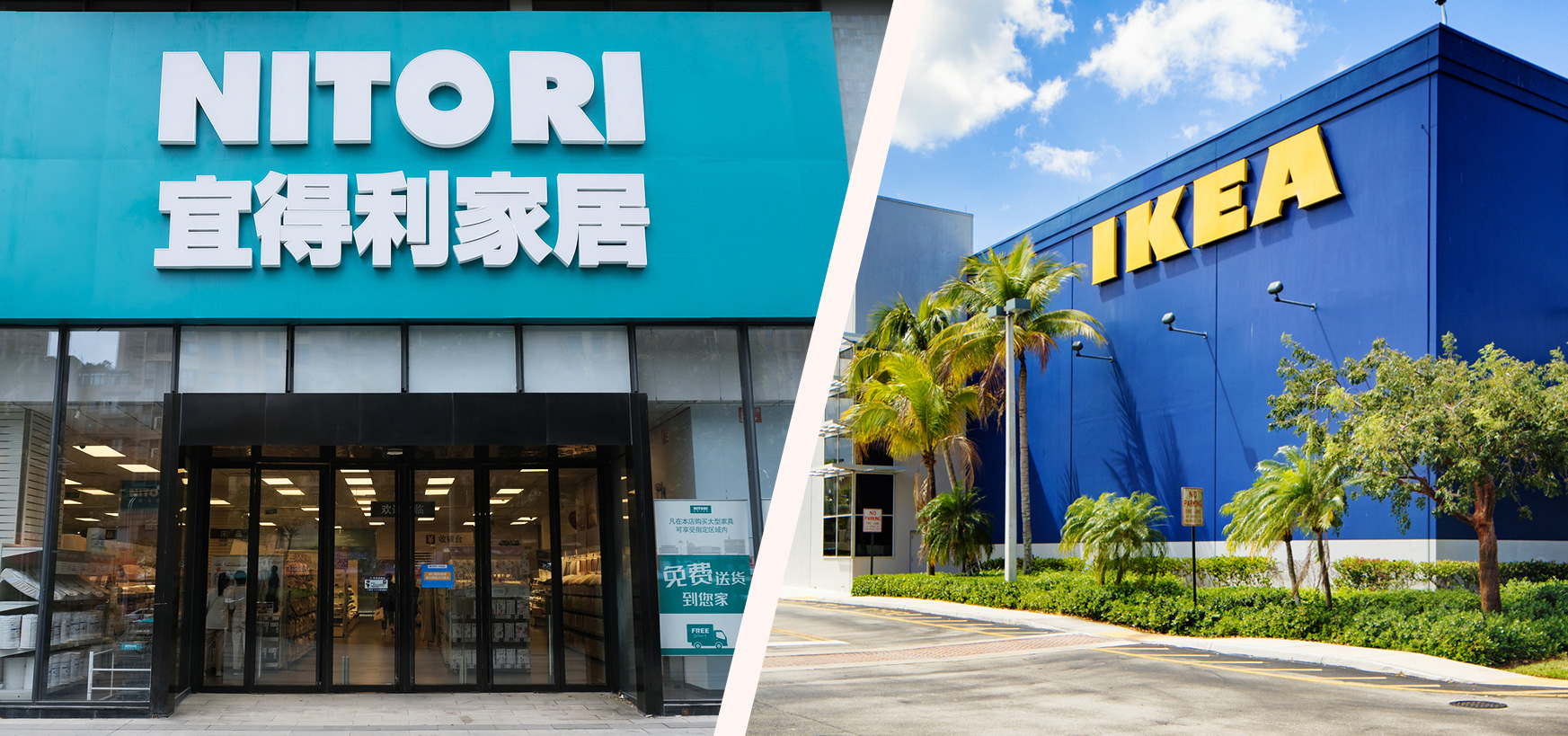
Fifty years later, Nitori operates more than 1,000 stores across Japan, China, Taiwan, Southeast Asia, and the United States, generating over $6 billion in annual revenue. For many Japanese households, it’s not merely a place to buy a bed or table—it’s the default choice for furnishing an apartment. Little wonder, then, that it’s considered Japan’s answer to IKEA.
For decades, Nitori has been synonymous with affordable furniture in Japan, leveraging everything from automation to vertical integration and just-in-time logistics to keep prices low. Even during the 2008 financial crisis, the company continued announcing price cuts—12 in total—while sticking to its fundamentals. This tightly controlled flywheel of affordability, consistency, and trust has cemented its position as Japan’s leading furniture brand. Where other brands treat furniture as lifestyle, Nitori made their products an aspect of infrastructure.
Making sure the curtains match
In Japan’s fragmented furniture market of the 1960s, retail was built around wholesalers and one-off designs. Prices were high, styles didn’t match, and service was generic. Nitori started by solving that problem one variable at a time.
Following a rough period that brought the company to the verge of bankruptcy, Nitori took an eye-opening trip to the United States in 1972 to understand what American furniture retailers were doing differently. What he saw seemed contradictory—not only was furniture cheaper in the US, but it was also of higher quality and offered far greater variety. Most importantly, the furniture matched everything else in the room.
Akio Nitori returned with a clear vision: customers want rooms that feel intentional. He began designing living sets that matched in form and tone—sofas that complemented curtains, rugs that aligned with shelf colors. He streamlined product palettes, simplified display formats, and leaned heavily on modularity. The goal was not luxury, but order.
That same logic extended to operations. By the 1980s, Nitori had begun bypassing wholesalers and sourcing directly from manufacturers. In the 1990s, it opened its own factories in Indonesia and later Vietnam. Today, roughly 90% of Nitori’s products are manufactured outside Japan—many in factories that Nitori supplies with its own raw materials.
This deep vertical integration creates more than just cost control—it creates flow. Inventory moves through the most efficient path possible, with automated systems handling picking and delivery coordination. Some stores receive no bulk stock at all; large items are shipped straight from warehouses to customer homes, routed by software that optimizes truck delivery paths in real time.
For customers, this translated into the perfect experience: clean showrooms, low prices, and a convenient, efficient delivery network. Nitori would even set up the furniture for you. The company’s slogan, which translates to “more than you paid for,” perfectly captures its founder’s desire that their products be “inexpensive, not cheap.”
When Kaizen meets Omotenashi
Nitori’s internal systems are grounded in what the company calls “100x thinking.” This isn’t about scale for its own sake, but about setting long-term goals so ambitious they force creative infrastructure solutions.
Akio Nitori’s early company vision—the “7-1s”—included targets like ¥1 trillion in revenue, ¥10 billion per store, and ¥10 million average employee salaries. These targets were set when the company had only a few dozen outlets. Most have since been met or surpassed.
Execution happens at ground level through meticulous feedback loops. Every store submits weekly reports while managers analyze what sold, what didn’t, and propose adjustments. Mid-level teams review stock movement, customer data, and shelf placement in regular cycles. Long-term vision is systematically broken down into quarterly and weekly actions. As a result of this constant calibration, the company achieved over 24 years of continuous revenue and profit growth until the momentum finally slowed in 2024.
There’s a term often invoked in Japanese retail: omotenashi. It means hospitality, but more precisely, the act of anticipating what a customer needs before they ask. Nitori has operationalized this concept—not through white-glove service, but through price clarity, quick delivery, and layouts that let shoppers furnish an entire apartment without guessing whether the curtains will clash.
Local first
Since 2007, Nitori has opened stores across Taiwan, mainland China, Southeast Asia, and the United States. Unlike many global retailers, it didn’t attempt to export a fixed model. In China, it launched first in a second-tier city—Wuhan—before expanding to bigger metros. In Thailand and the Philippines, it prioritized malls over standalone stores. In each market, the product mix is carefully adjusted. In China, 60% of stock is designed in collaboration with local teams.
In the United States, Nitori adopted a new banner—Aki-Home—and introduced smaller-format stores that emphasized compact, clean-lined furniture. They hired veterans from Disney to train staff on customer flow and in-store experience. Sales grew modestly, but the approach was deliberate. Nitori didn’t need to scale instantly; it needed to learn the tempo of each market.
At home, it remains a juggernaut. In Japan, if you’re moving into a new apartment, Nitori is the default choice. That domestic strength now funds a global ambition: 3,000 stores and ¥3 trillion in annual sales by 2032. More than tripling its footprint in under a decade is bold—but Nitori has already built the engine to achieve it.
What leaders can learn from Nitori
- Design starts at the warehouse. Good products mean little without reliable supply and fulfillment. Nitori treats manufacturing and logistics as equal parts of the value proposition.
- Don’t chase disruption. Build consistency. Nitori didn’t outpace rivals through novelty, but by removing inefficiencies others accepted as normal.
- Adapt to place, not just market. Nitori’s international growth succeeds because it adjusts formats and merchandising country by country—without diluting its brand’s center of gravity.
- Grow slow when needed. Move fast when ready. Whether it’s a midnight factory deal or a five-year plan, the company moves at the speed its systems allow.
Relentless growth
There’s a reason Nitori keeps increasing sales during recessions, why it buys up chains like Shimachu to expand in Tokyo, why it trains and hears from its staff weekly. The company is not in the business of furniture—it’s in the business of rhythm: the quiet, repeatable cadence of making good homes more attainable.
That rhythm scales. And for anyone studying what makes Japan’s most disciplined companies tick, Nitori remains one of the most instructive—and quietly formidable—examples working today. If you’re living in Japan and want to furnish a small apartment without compromising on form or function, Nitori remains the quiet default.